Rahul Ranjan
Incoming PhD Student | Edge AI & Mobile Health
Robust Biomedical Signal Processing on Mobile Devices
Monash University
Focus
Edge AI + Mobile Health
On-device clinical vitals
Funding
2 Competitive Scholarships
Fully funded PhD
Publications
2 Peer-Reviewed
Springer Nature + IEEE

Research Snapshot
Edge AI + Mobile Health
Clinical-grade, on-device vitals
- Contactless vitals from smartphone camera (no wearables)
- Robust to motion artifacts & poor lighting
- Edge-optimized models (real-time inference)
- Clinically validated (AAMI/BHS standards)
About
About & Contact
I build clinical-grade AI that runs on smartphones, not server farms.
My PhD research solves the hardest problem in mobile health: extracting accurate vital signs (HR, SpO₂, BP) from noisy video in the wild—motion artifacts, poor lighting, diverse skin tones.
I combine deep signal reconstruction (encoder–decoder models like U-Nets/autoencoders) with edge-first deployment (distillation + quantization) to deliver real-time inference on mobile NPUs via CoreML/ONNX—putting reliable vital-sign monitoring in your pocket.
Recent Updates
- March 2026 Starting PhD in Electrical & Computer Systems Engineering at Monash University (16 March 2026).
- December 2025 Completed Master of Artificial Intelligence at Monash University.
- November 2025 VITAL Net paper accepted at IEEE Applied Sensing Conference 2026.
- May 2025 Published journal paper on blood pressure estimation in Journal of Medical Systems.
Technical Skills
Programming Languages
ML/Deep Learning
Computer Vision & Signal
Data & Visualization
Edge AI & Mobile
Tools & Infrastructure
Contact
Email: rahulrkm0038@gmail.com
Phone: +61 435 844 977
LinkedIn: linkedin.com/in/rahul-ranjan-b595891b1
Google Scholar: scholar.google.com.au
Education
-
PhD, Electrical & Computer Systems Engineering (ECSE)
Monash University, Melbourne, Australia (2026–2029)
-
Master of Artificial Intelligence
Monash University, Melbourne, Australia (2023–2025)
-
M.Sc. (Hons.) Physics; B.E. (Hons.) Electronics & Instrumentation
Birla Institute of Technology and Science (BITS), Pilani, India (2017–2022) — Monte Carlo Simulations of Phase Transitions in Ising Models
Awards & Funding
-
Monash Research Scholarship
Electrical and Computer Systems Engineering — Fully funded PhD (2026–2029)
-
Faculty of Engineering International Postgraduate Research Scholarship
FEIPRS — Competitive international award (2026–2029)
-
The Duke of Edinburgh's International Award
Silver (2015)
Collaboration
Looking for
- Clinical and translational partnerships for mobile vital sign validation
- Industry collaborations for on-device deployment and productization
- Cross-disciplinary research on robust biomedical signal processing
What I bring
- End-to-end rPPG/PPG pipelines (data → model → evaluation)
- Clinical-grade evaluation aligned to AAMI/BHS standards
- Edge-optimized deployment on mobile NPUs (CoreML/ONNX)
Open to collaborations and grant partnerships in 2026.
Funding-ready Profile
Outcomes
- 95%+ HR accuracy on mobile rPPG in real-world conditions
- <5 mmHg BP MAE aligned with AAMI/BHS criteria
- Reproducible evaluation scripts and deployment-ready checkpoints
Capabilities
- Robust signal processing + deep learning fusion
- Edge inference optimization (quantization, distillation)
- Clinical validation pipeline and reporting
Research
Research & Publications
Selected Publications
Evolving Blood Pressure Estimation: From Feature Analysis to Image-Based Deep Learning Models
Roha, V. S., Ranjan, R., & Yuce, M. R.
Journal of Medical Systems, Springer Nature, 49(1), 97 (2025)
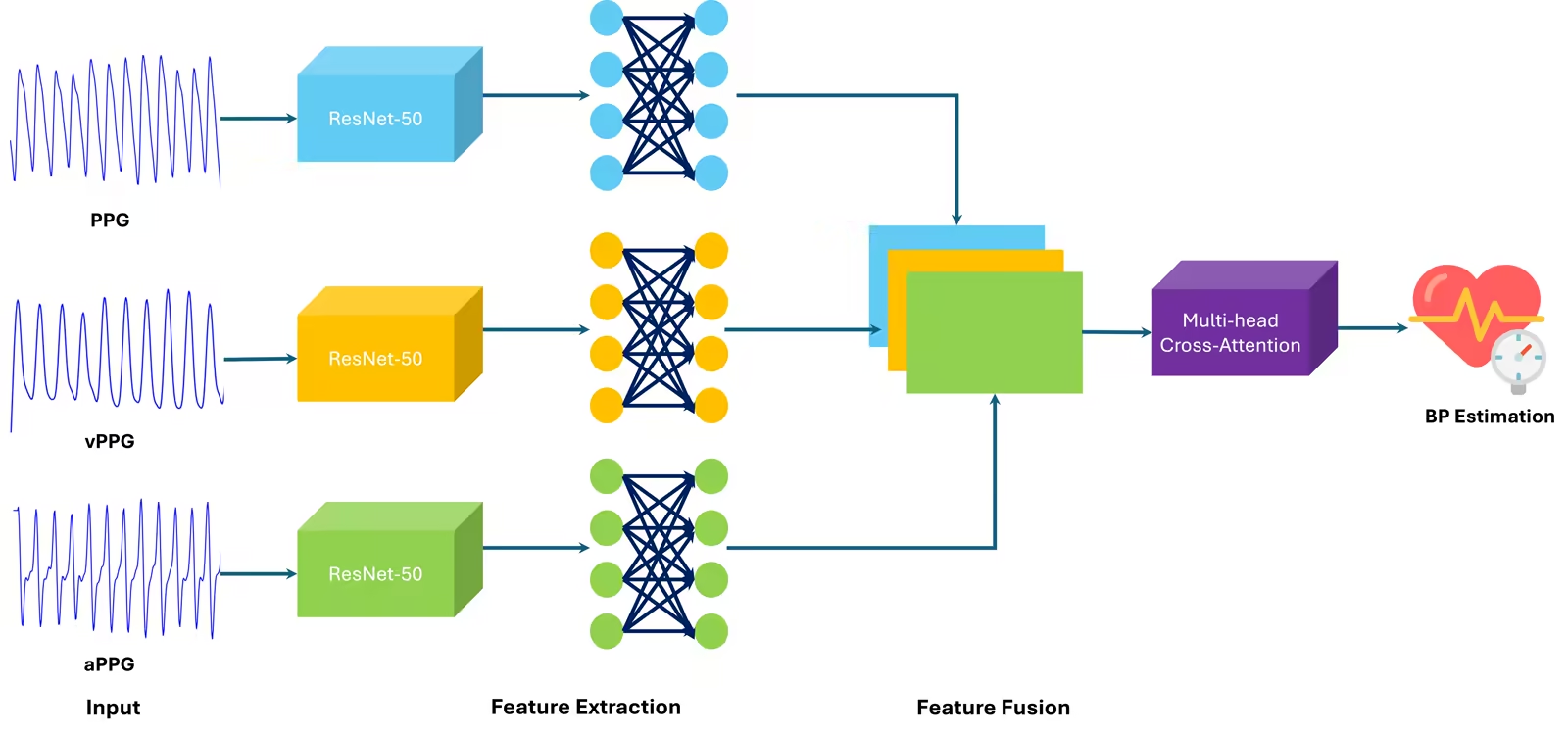
Introduces IMCA-PPG, an image-based multimodal framework that converts single-site PPG into PPG/vPPG/aPPG visual streams, extracts embeddings with ResNet-50, and fuses them with multi-head cross-attention for cuffless BP estimation.
Why this matters: Reliable cuffless BP estimation from one sensor makes continuous cardiovascular monitoring more practical for mobile and remote care.
VITAL Net: A Hybrid Framework for SpO₂ and HR Estimation Using Smartphone rPPG Video
Ranjan, R., Roha, V. S., & Yuce, M. R.
IEEE Applied Sensing Conference (2026)
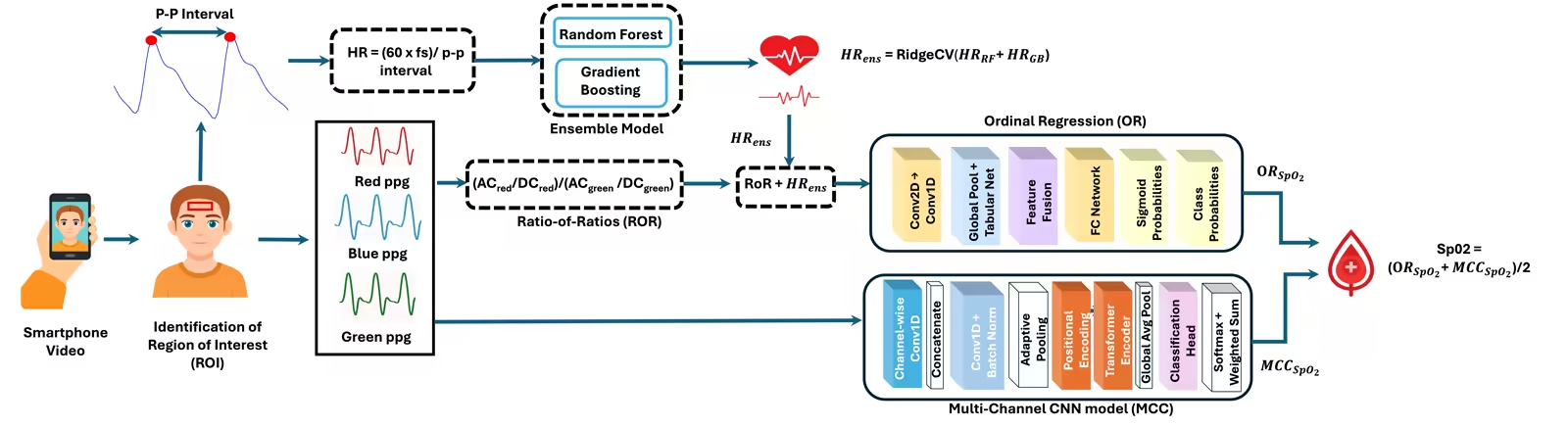
Presents a unified smartphone-video pipeline for contactless SpO₂ and HR estimation by combining physiology-aware Ratio-of-Ratios features with hybrid ensemble and CNN modeling.
Why this matters: Turns a standard smartphone camera into a low-cost vital-sign monitor for settings where wearables or clinical devices are not always available.
Research Interests
- Contactless vital sign monitoring from smartphone cameras (rPPG)
- Robust signal processing for noisy, real-world physiological data
- Edge AI: efficient deep learning on mobile devices with limited compute
- Clinical validation: meeting AAMI/BHS standards for medical-grade accuracy
Projects
Research Projects
Vital Sign Monitoring (Mobile)
P1Computer Vision · PyTorch · ResNet + Attention
Converted single-sensor PPG into visual representations (PPG, vPPG, aPPG) and trained ResNet-50 with multi-head attention to estimate HR/BP on-device; aligned outputs to clinical AAMI/BHS standards.
- Built end-to-end pipeline from raw PPG to vPPG/aPPG transformations with reproducible preprocessing.
- Trained on A40 GPUs with augmentations for motion/illumination noise; validated against AAMI/BHS clinical thresholds.
- Delivered mobile-ready checkpoints plus evaluation scripts for clinician partners.
Predictive Maintenance for Rail
P2XGBoost · Time-series features · SQL
Engineered rolling/lag features and deployed XGBoost models with drift checks and retraining cadence; reduced unplanned downtime 18–22% and delivered 48-hour lead time on failures.
- Added rolling statistics and lag features over telemetry feeds.
- Set up drift monitoring and monthly retraining cadence; automated SMTP/Slack alerts for top risk assets.
- Delivered dashboards and downtime reduction reports to 50+ stakeholders.
Data Flow Synchronicity Checker
P3Python · Hashing · Automation
Automated file integrity checks across multi-repo FPGA verification flows using SHA-256, manifest diffs, and cron-based scheduling; shipped email digests for mismatches to keep teams in sync.
- Computed SHA-256 checksums against Artifactory/Perforce manifests to catch drift across repos.
- Cron-based nightly runs with mismatch digests emailed to verification engineers.
- Improved verification workflow efficiency ~30% by eliminating manual sync checks.
Experience
Research & Professional Experience
Master's Thesis (Computational Physics)
Department of Physics, BITS Pilani
- Investigated phase transitions in ferromagnetic materials using Monte Carlo simulations (Metropolis algorithm) on 2D/3D Ising lattice models with periodic boundary conditions.
- Calculated thermodynamic observables (energy, magnetization, susceptibility, specific heat) across temperature sweeps; achieved 40% runtime reduction via vectorization.
- Extracted critical exponents (β, γ) using finite-size scaling and power-law fitting; analyzed impact of disorder on transition sharpness.
Information Technology Officer
Aglow Engineers, Kolkata
- Established the company's first centralized data infrastructure by migrating manual entry systems to SQL, creating a robust, queryable database for all operational logs.
- Accelerated stakeholder decision-making by developing Python Automation scripts that reduced technical interpretation time through automatically emailed plain-English summaries.
- Reduced system downtime by 22% and achieved 89% prediction accuracy in vulnerability detection by building proactive forecasting models using Random Forest & LSTM.
Software Intern
Centre for Railway Information Systems (CRIS), New Delhi
- Predicted asset failures 48 hours in advance with 94% accuracy by implementing Anomaly Detection within WISE modules using Python and XGBoost.
- Reduced workshop downtime by 18% by deploying Predictive Maintenance models across 200+ railway assets.
Software Development Intern
Xilinx (now AMD), Hyderabad — Timing Team, Device Capture Group
- Streamlined file-hash verification for 25+ design engineers by developing and deploying the "Data Flow Synchronicity Checker" tool across FPGA teams.
- Improved team workflow efficiency by 30% by building production infrastructure with nightly automated checks (1000+ file validations/day) using cron-scheduled Bash jobs.